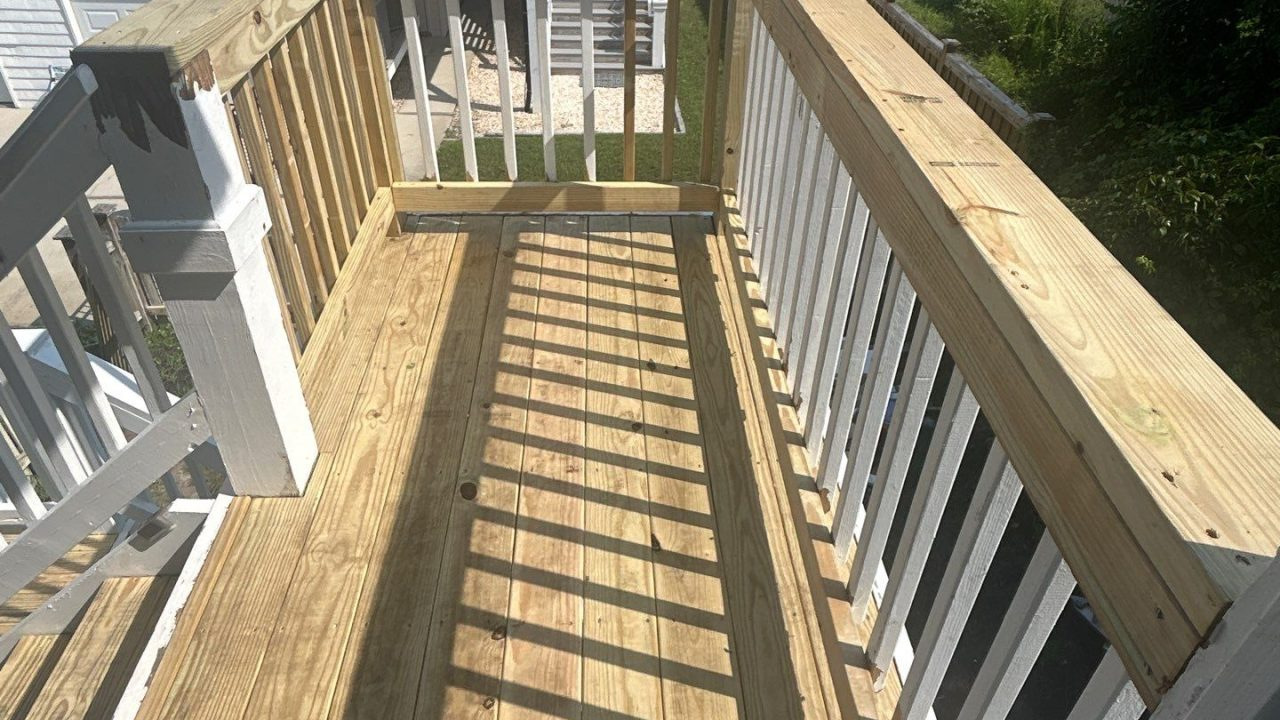
Photo: timber deck landing and rails at an RGR Construction and Roofing parent-company project in Carolina Beach, NC. Seasoned Exteriors is an RGR division. The photograph illustrates an existing wood deck; it is not a composite installation or an assessment of the pictured structure.
Can you replace wood deck boards with composite? Often, yes—but only if the existing structure is sound and suitable for the exact decking product. The decision depends on the frame, supports, connections, board layout, drainage and stairs. Removing the old surface gives the contractor a chance to check what is underneath before committing to new boards.
If your Jacksonville deck needs frequent attention, composite decking can be an appealing next step. The important question is what the change involves beyond the walking surface. A quote for boards alone tells you very little about whether the finished deck will work well.
This guide focuses on resurfacing an existing deck. If you are also moving stairs or changing its footprint, start with our deck layout planning guide and explain those changes during the first visit.
Start by separating the surface from the structure
The deck boards are the surface you walk on. Beneath them, joists carry the boards; beams, posts, footings and connections carry the assembly. A ledger may connect the deck to the house. New decking does not renew all those parts or tell you how much useful life they have left.
Ask the contractor to describe the existing structure before discussing colors. What can be seen from below? Which areas are concealed? Are there signs of movement, decay or deteriorating connections? A first visit may establish a likely scope, but some conclusions must wait until the old boards are removed.
Fiberon’s installation guidance allows reuse of existing framing only under stated conditions, including sound framing, correct support spacing, airflow and drainage. The principle matters more than the brand name: resurfacing is a conditional decision, not a shortcut around structural assessment.
If the deck feels unstable, a railing moves or a support appears damaged, keep people off the affected area and arrange an assessment. A homeowner walk-through is useful for describing concerns, but it cannot establish structural capacity.
Choose a product before finalizing the framing work
“Composite decking” describes a category, not one installation specification. Ask the proposal to name the manufacturer, product line, board profile and fastening system. That lets the contractor compare the actual instructions with the existing deck instead of assuming every board can use the same support arrangement.
Board direction matters. Running new boards diagonally or adding a border can change the support needed beneath them. The old pattern may be straightforward to reuse, while the pattern in an inspiration photo may require additional framing.
Trex’s resurfacing guide calls for checking framing condition, hardware, spans and spacing, and planning support for decorative patterns. Ask your contractor to identify those details on your deck. A neat border is a design choice with construction work behind it.
Keep product approval separate from appearance. A board sample helps you choose a finish; the current installation guide and project review establish how that product may be used. Do not use a generic online spacing number as the specification for your deck.
Give stairs, railings and the house connection their own scope
A resurfacing proposal should say what happens at the edges of the project. Will the stair treads change? Are the rails staying, being modified or being replaced? Does the proposed surface affect the transition at the back door? These are easier to discuss before demolition than when the deck is partly open.
Changing decking thickness can affect the finished relationship between steps and landings. Ask for the complete stair arrangement to be checked against the applicable requirements and the selected product’s instructions. Decking guidance for the main walking surface should not be assumed to cover stair installation.
For rails you want to keep, ask how their condition and attachment will be evaluated. A clean-looking railing does not answer what is happening at the connection. At the house, clarify whether the scope includes inspecting the ledger connection and water-management details, and what happens if concealed damage is found.
Deal with moisture before covering the frame
Look around the deck after ordinary rain from a safe location. Note standing water below it, clogged gaps, downspouts discharging toward supports or stored items blocking access underneath. Share photographs with the contractor. These observations help identify where a closer review is needed.
A different walking surface does not eliminate the need for drainage and ventilation. The selected product may have specific clearance and airflow requirements. Ask how those will be met at a low deck or behind existing skirting. Do not add a new enclosure below the deck without discussing its effect on airflow and access.
If protective tape is proposed for retained wood framing, ask which product will be used and where. It belongs in the written scope alongside any repairs. Covering deteriorated material with tape is not an explanation of how that material becomes suitable for reuse.
Compare complete options and practical upkeep
Ask for two clearly described options when the frame’s condition makes the decision uncertain: resurfacing with identified repairs, and a more extensive rebuild. Compare what each includes, what is retained and what remains unknown. A lower initial figure is less useful if substantial work has been left out.
Include demolition, disposal, framing changes, stairs, rails, fascia and finish details in the comparison. Ask how unexpected conditions will be photographed, priced and approved. You should know when work will pause for a decision and how the back door or yard will remain safely accessible.
Read the cleaning instructions and warranty for the exact decking product before choosing it. “Low maintenance” still calls for an ownership routine. Ask about permitted cleaners, nearby grills, outdoor rugs and everyday spills. View samples beside your siding and in the sunlight the deck actually receives, rather than choosing solely from a screen.
Prepare a useful Jacksonville deck estimate request
Send your address, a few overview photographs, the approximate age of the deck if known, and your main concerns. Include any old plans or permit records you already have. Explain whether the goal is fewer finishing chores, a different appearance, a repaired surface or a larger change.
Confirm permitting responsibilities for the actual scope and jurisdiction. Onslow County’s deck guidance describes plans and inspections for deck construction; it does not establish that every resurfacing proposal has the same requirements. Ask the applicable building department or contractor what your address and proposed work require.
Seasoned Exteriors provides deck construction, wood deck repair and general contracting in Jacksonville and Onslow County. Request an estimate from Seasoned Exteriors to discuss your existing deck, material preferences and the assessment needed before deciding what to retain.
Frequently asked questions
Can composite boards go directly over the old wood deck boards?
Do not assume they can. Resurfacing normally involves removing the old walking surface so the frame can be inspected and the new product supported and fastened as specified. Ask for a proposed assembly that follows the exact manufacturer’s instructions; simply adding a layer leaves important conditions hidden.
Will my existing joist spacing work with composite decking?
It depends on the selected product, the board direction, the application and the project requirements. Have the contractor measure the existing arrangement and check it against the current installation guide. Diagonal patterns, borders and stair treads can need different support details from a straight deck surface.
Can I keep the current railings when I replace the deck boards?
Possibly. The proposal should identify which rails and posts will remain, how their condition and connections will be assessed, and whether the new surface changes any relevant dimensions. Ask for the rails and stairs to be reviewed as part of the finished deck rather than treated as an automatic exclusion.
Does composite decking fix rot in the frame underneath?
No. The walking surface does not repair damaged joists, posts, beams or connections. The contractor needs to identify unsuitable components and the work required before covering the frame. Drainage and airflow also need attention where they are contributing to the problem.
Is resurfacing always less expensive than rebuilding a deck?
No single answer fits every deck. Reusing suitable parts can reduce some work, but extensive repairs, new support for the chosen boards, stair changes and railing work may narrow the difference. Compare written scopes for complete options and agree on how concealed damage will be handled before the project starts.